Quant Reports · Published
The two-high decade: how defenses bent football, and fantasy bent with it
Read as Markdown · JSON · Interactive board
Dated research snapshot. Conclusions apply to the populations and test periods described; this is not a current player recommendation.
Somewhere around 2020, quarterbacking stopped getting easier. Passing yardage had climbed for two decades, fantasy QB scoring peaked, and then the league started drifting the other way, season after season. Our hypothesis going into this study: defenses collectively moved to two-deep safety coverage to take away the explosive pass, and everything downstream, from checkdown rates to running back revivals to your league's draft board, follows from that one structural change.
The first half of the check is league tracking data, and it leaves little doubt. The NFL's own analytics group reports that two-high safety looks on passing downs rose from 44% in 2019 to 63% in 2024, and 2024 set the record for two-deep shells on dropbacks since tracking began in 2016. Explosive pass rates against those shells run around 9%, against 12.7% when defenses play zero-high. League passing yardage fell four straight seasons through 2024, from roughly 496 combined yards per game in 2020 to 403. Coaching coverage tells the same story with names attached: the Fangio-tree structure, two deep safeties over a light box, spread across the league as his assistants became coordinators.
The second half of the check is our own play-by-play, ten regular seasons of it, and the signatures are all there.
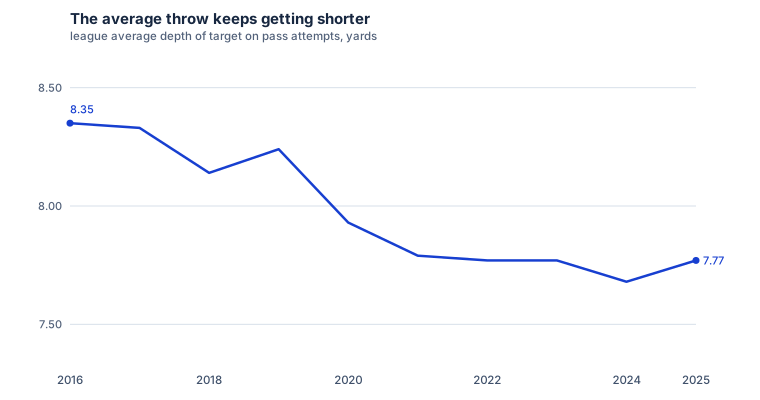
The average throw has shortened from 8.35 air yards in 2016 to about 7.7 since 2023. Offenses didn't stop attempting deep shots entirely, the 20-plus air-yard share only drifted from its 2019 peak of 12.3% down to around 11.4%. What changed is what those shots are worth against two deep safeties, and how offenses responded between them: more checkdowns, more yards after catch, more early-down runs. Early-down pass rate fell from about 54% through 2020 to 52.1% last season.
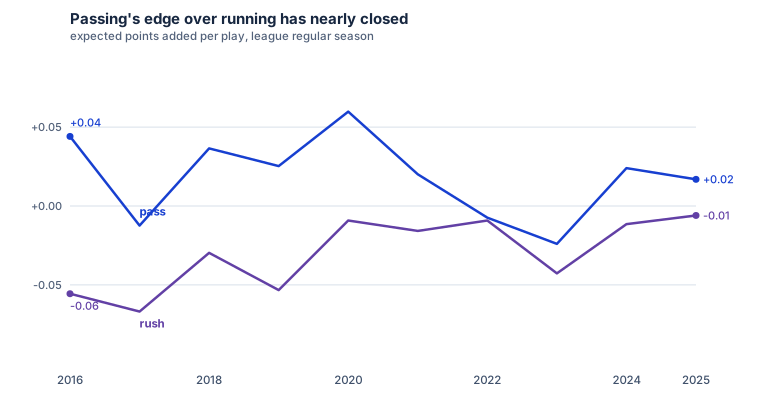
Here is the chart that explains a decade of football strategy. In 2016 a pass play was worth about a tenth of an expected point more than a run. That gap is the entire reason the league passed so much. By 2022 the two lines touched, and they have stayed within a few hundredths since. Passing is still narrowly ahead, but the arbitrage is gone, and with it went the incentive to drop back 40 times. Defenses accepted worse run defense as the price: the stacked-box rate faced by ball carriers fell from about 26% in 2016 to 20-22% across 2019 through 2024 in the Next Gen tracking. Light boxes are the tax two-high pays, and in 2024 the league finally collected, with sixteen 1,000-yard rushers, the most since 2010.
What it did to fantasy
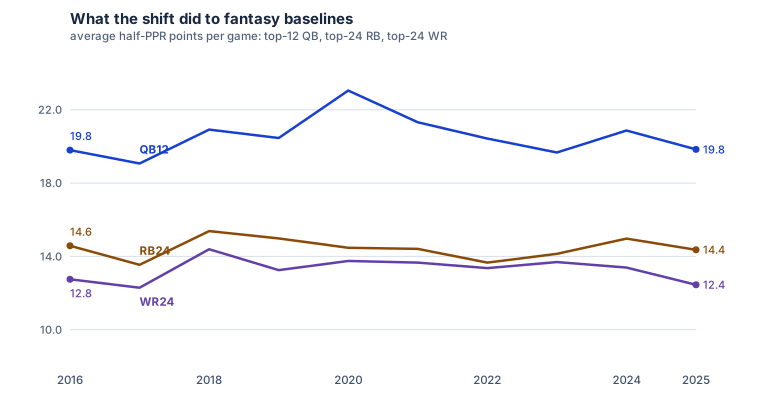
The top-12 QB baseline peaked at 23.1 half-PPR points per game in the 2020 passing bonanza and has lived around 20 since. The top-24 WR baseline peaked in 2018 at 14.4 and sat at 12.4 last season. The quietly stable line is RB24: it never collapsed the way the position's draft stock did, and 2024's 15.0 was effectively identical to 2016.
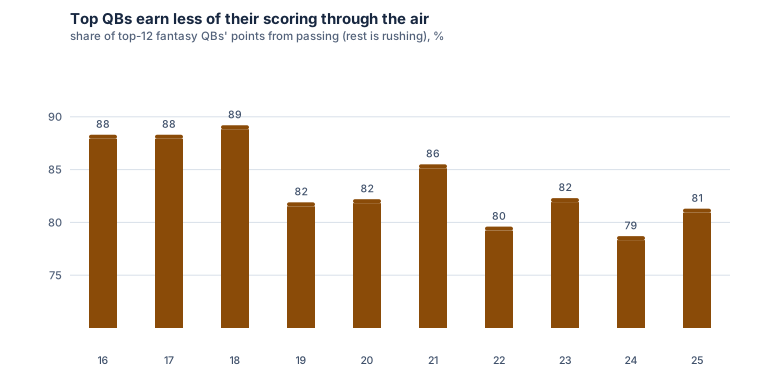
The QB story underneath the flat baseline is the best part. Top-12 QBs earned 88-89% of their fantasy points through the air in 2016-2018. Since 2022 that share has run 79-82%. The position adapted to worse passing conditions by scoring with its legs, which is why the QBs who can't run have quietly become the position's value trap: they absorb the full weight of the two-high era with no rushing offset. This connects to a bias we published in our draft research, where season projections systematically overshoot rushing quarterbacks' passing-era comps, and weekly platform projections run hot on the QB position as a class.
The meta is already turning again
One number in our 2025 data doesn't fit the trend, and it's the interesting one. The stacked-box rate jumped back to 26%, its highest level in our sample since 2016. That reads like the counter-move arriving: defenses that spent five years selling out against the deep ball are re-loading the box against the run game that punished them for it. If that holds, the next beneficiaries are play-action deep passing and the receivers who live over the top, which is roughly where this cycle started ten years ago.
For draft season, the practical reads are unglamorous. Price WR baselines against what the position produces now, not what it produced in 2018. Treat a quarterback's rushing yardage as structural floor rather than bonus. Respect that elite RB volume is real again while remembering the league just started defending it. The market's decade-old habits are the edge, on both sides.
Sources: NFL Football Operations on defensive schemes · ESPN on the passing decline · The Ringer on explosive passing · Sharp Football on the Fangio shell · NFL.com on the RB renaissance. All play-by-play, EPA, aDOT, box-count, and fantasy-baseline figures computed from our own ten-season dataset (2016-2025, half-PPR).