Quant Reports · Published
The 2026 standard draft: a stampede, a tar pit, and free quarterbacks
Read as Markdown · JSON · Interactive board
Dated research snapshot. Conclusions apply to the populations and test periods described; this is not a current player recommendation.
Standard leagues have gone all-in on running backs this summer. Eight of the first twelve picks by ADP are running backs, and fifteen of the first twenty-four. One of them, Jeremiyah Love, has never played an NFL snap and is going fifteenth overall. We wanted to know whether the projections back that up, so we lined up the full 2026 consensus projections against where players are actually being drafted in standard leagues, with last season's carries, targets, and touchdowns underneath. Drafters have part of this right, and one habit in the middle rounds looks like it will quietly cost people their season.
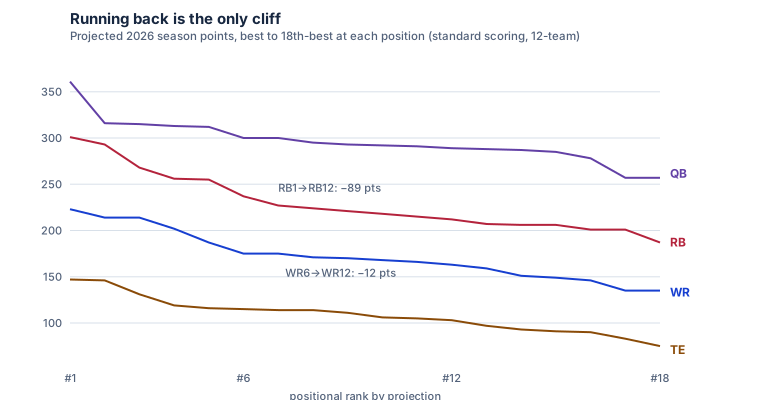
Going RB early is right
The best running back this year projects 89 points ahead of the twelfth-best. That is the biggest drop-off at any position, more than five points a week between the back who goes first and the last one that qualifies as an RB1. Wide receiver looks nothing like that. The sixth-best receiver and the twelfth-best are separated by twelve points across the whole season, less than a point a week, so if you miss the top receivers you can shrug, knowing the WR you get in round five is nearly the same player as the one who went in round three. Miss the top running backs and there is nothing behind them.
The league is cooperating too: two seasons ago the NFL had sixteen 1,000-yard rushers, the most since 2010, something we traced back to how defenses now play coverage in our two-high report.
The rounds four through eight trap
After the real workhorses are gone, drafters in standard leagues keep taking running backs anyway, and this is where the losses pile up. A quick yardstick first: in a 12-team league, the last running back anyone actually starts projects around 129 points, so a back projected under that is the kind of player who will be sitting on waivers in September. Now the picks. RJ Harvey is going 40th overall, a round-four pick, and projects 131 points. That is a waiver-wire back at a round-four price. Brian Robinson costs an early round-seven pick and projects 43 points below the bar. Tyler Allgeier, pick 89, is 50 below it. James Conner is going in round eight while projecting fewer than half the points of a September waiver pickup. Blake Corum and Kyle Monangai both go inside the top 70 with projections sitting right at that same waiver bar.
Standard scoring itself feeds the mistake. Compare the same players' price in PPR drafts: Conner goes 60 picks earlier in standard than in PPR, Robinson 44 earlier, Allgeier 43. The thinking is easy to reconstruct. These backs don't catch passes, and catches don't score here, so drafting them costs nothing. What that logic misses is that a back already projected below the waiver bar doesn't become a better pick just because the scoring stopped counting passes he never caught. For what it's worth, Jadarian Price goes sixty picks after Harvey and projects thirty points more.
So in rounds four through eight of a standard draft, skip the backs whose whole pitch is that they have a starting job. Spend those picks on receivers, who barely drop off, on one of the veteran tight ends going cheap, or on the bounce-back players covered below.
Quarterback is nearly free
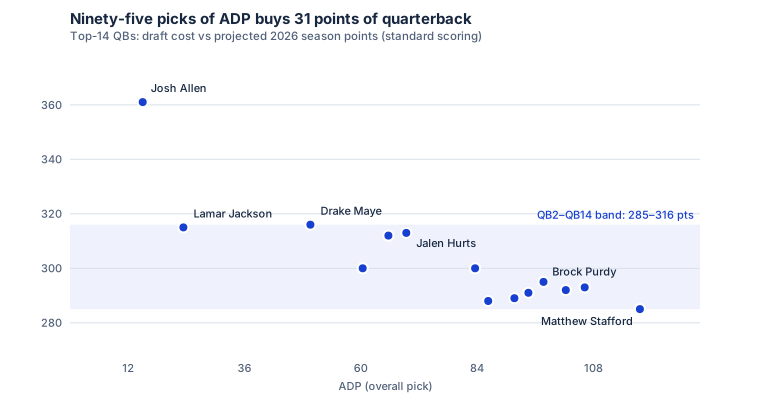
Josh Allen projects 361 points and stands alone. The next thirteen quarterbacks, from Drake Maye at 316 down to Matthew Stafford at 285, are separated by 31 points across a full season, under two points a week, and drafters spread them across ninety-five picks. Brock Purdy in round nine projects within 22 points of Lamar Jackson in round two. Dak Prescott, Patrick Mahomes, and Stafford all last past pick 95 while projecting within 30 points of Jackson.
Wait on the position, then draft two. When we checked bench spots against how seasons actually played out in real leagues, the backup quarterback was the one bench player who reliably paid off, worth about 14 extra points a season, while benches stuffed with extra running backs slightly hurt their teams. Waiting on quarterbacks costs almost nothing in this format, and it hands you the exact middle-round picks the RB trap wants to burn.
Rookies cost extra
Across the first ten rounds, rookies go about eight picks earlier than their projections justify, and players 28 or older go about four picks later than theirs. Drafters pay up for what a player might become someday and get a discount on what he still is right now.
Tight end shows it best. Oronde Gadsden, a rookie, goes 83rd overall while projecting as the TE21, a player you would never start. Harold Fannin is the fifth tight end drafted and projects ninth. Colston Loveland and Tyler Warren both cost top-60 picks with projections that belong five rounds later. Meanwhile 36-year-old Travis Kelce is the nineteenth tight end off the board and projects tenth, and Dallas Goedert goes twelfth at the position while projecting seventh. Receivers show the same pattern: rookies Carnell Tate and Jordyn Tyson cost top-70 picks while projecting like waiver adds, Luther Burden goes 40th overall with a WR3's projection, and Alec Pierce projects as a startable WR23 while being drafted as the WR40.
Paying for upside is fine, and projections are always cautious on rookies because there is no pro track record to build on. Paying three rounds of upside tax at tight end, the position where the twelfth-best player scores almost what the sixth-best does, is where it stops making sense.
Who got lucky last year, and who got robbed
For every player we track the points his carries and targets should have produced, valuing each touch by where on the field it happened (we compute this on half-PPR scoring). Compare that to what he actually scored and you can see who earned his 2025 stat line and who rode touchdown luck.
Justin Jefferson got robbed. He saw 30% of Minnesota's targets last season, a workload only a few receivers in football ever get, and still scored 51 points less than that workload normally produces, the biggest gap of any draftable player. He opens this summer as the sixth receiver off the board at pick 18. Emeka Egbuka's rookie season had the touches of a 195-point year and scored 33 less. Quinshon Judkins and Ashton Jeanty both got fed like stars and finished 31 and 24 points short of their touches. Workloads like these usually get paid the following season.
The lucky column is all touchdowns. Dallas Goedert scored 40 points more than his touches explain, on eleven TDs. George Kittle ran 35 over on seven. Davante Adams got 52% of his standard-scoring points from touchdowns, Tee Higgins 44%. In PPR a touchdown drought still leaves catch points behind, but standard has no cushion under it, so before paying for anyone's big 2025 finish, check how much of it was touchdowns. Goedert shows up here as both a cheap veteran and a touchdown-luck case, which is roughly why his price is fair, and we would still rather draft him than Fannin.
The plan
Six rules for a standard draft, each backed by our research on real leagues:
- Start your draft with running backs and mean it. The drop-off is real and no other position has one.
- Get out of the RB pool around round four. From there through round eight, take the receivers and cheap veteran tight ends, plus the bounce-backs above.
- Draft your starting QB after your other starters are set, then grab a second QB late. The projections make the wait safe, and the bench numbers make the backup worth it.
- Relax about your queue. Measured across thousands of real draft picks, where a player actually goes swings by about 18 picks even in the first two rounds, and by nearly 30 around round ten. Your guy makes it back to you more often than the panic says.
- Treat kicker and defense separately. Our newer report, The pick-110 question, found no stable preseason identity for an elite defense and a strong real-wire streaming result, so take D/ST late. The very top kicker projection retained some signal, but most kicker differences still belong in the final few rounds.
- Championship teams are, on average, top-third scoring teams from September on, so draft the most projected points even when the roster looks lopsided, and fix the rest on waivers.
We'll refresh this report as ADP moves through August, and a PPR edition is coming. Projections are FantasyPros consensus scored for standard leagues, ADP is per-format market consensus, and the touch-by-touch numbers come from our own model built on 2025 NFL tracking and charting data.